
The cult of St David

The ecclesiastical settlement would become known as Tyddewi (House of David) and was a famous centre of pilgrimage early in its history, attracting both foreign pilgrims of status and numerous Viking attacks by the ninth century. Its scholastic community was also famous throughout the Celtic world and in Anglo-Saxon England. When Alfred the Great wanted to establish a centre of learning at his court, he requested Asserius Menevensis, (Asser of St Davids) to join them. At that time, Asser had lived all his life at St Davids, being raised, tonsured, trained and ordained there. Yet Alfred’s desire to secure his service was such that he acquiesced to a number of delays and requests before finally agreeing that Asser could split his time between Alfred’s court and St David’s.

The cult of Saint David was actively encouraged by the cathedral’s pre-Norman Bishops, especially Sulien and Rhigyfarch, who would write Vita sancti Davidis episcopi, the standard Vita of the saint.

As the Normans advanced into Pembrokeshire, the city became a marcher borough, and the new hundred was named “Dewisland”. The cathedral was rebuilt during the Norman era and much of the earliest sections that are still extant, date back to the twelfth century. However, it is thought that this cathedral would have followed the layout of medieval structure and it continued to host its many ancient relics, including the remains of David.

At its height, the city was visited by many pilgrims, including noblemen and kings such as William the Conqueror in 1077, Henry II in 1171, and Edward I and Queen Eleanor in 1284. Pope Calixtus II decreed that two pilgrimages to St Davids were equivalent to one to Rome (“Roma semel quantum dat bis Menevia tantum”). This allowed a vast income to be raised from visiting pilgrims in the Middle Ages.

Posted in Latest News

Walking suggestion – St Non’s loop

Start and finish in St David’s.

Distance

8 miles / 13 kilometres for the whole route but there are a number of options to shorten the route during the tourist season by using the Celtic Coaster bus service as described.

It’s 7 miles/ 11 kilometres if looping back to St Davids by taking the inland route option from Porthclais,

6 miles / 10 kilometres if catching the bus from St Davids to St Justinian’s to start the walk or only 4 miles / 6 kilometres if using the bus service at both ends of the journey and only walking from St Justinian’s to Porthclais.

Along the way

This walk follows some fabulous clifftop sections and quiet country lanes in the footsteps of Dark Age saints who came here as pilgrims, and passes the turbulent and dangerous waters of Ramsey Sound. A wealth of wildlife can be seen, from dolphins and porpoise to peregrines and chough. And once on the coast, navigation is a dream – we just need to keep the sea on our right.

But we start in the UK’s smallest city, pretty St Davids and its quaint streets, cafes, boutiques and galleries. For such a small place, it really does pack a punch.

Posted in Latest News

Our top 3 things to do in St Davids

St Davids Cathedral

The 12th century St Davids Cathedral, built on the site of a much older religious buildings, is the reason for little St Davids’ outsize city status. Constructed from dusky purple sandstone, it’s one of Wales’ most iconic religious sites and sits tucked away in a sheltered vale beside the River Alun. Here you can learn about the history of St Davids, visit the impressive Treasury collection and enjoy home-cooked and locally-sourced food at The Refectory.

Oriel y Parc Gallery

Located in the National Park Information Centre, Oriel y Parc Gallery boasts a class A landscape gallery, exhibiting art and artefacts from the collection of Amgueddfa Cymru – National Museum Wales. Using objects from the art, natural history and industry collections, visitors are able to view a regularly changing exhibition programme.

The Bishop’s Palace

The brooding Gothic ruins of the Bishop’s Palace lie on the opposite bank of the river from the cathedral and provide a suitably dramatic backdrop for open air theatre performances in the summer. Bishop Henry de Gower’s legacy consists of the simpler east range, his private domain, and the grander south range, built for banqueting in the great hall.

Posted in Latest News

Some information about St Davids…

Here’s a little info on St Davids… 

St Davids is named after the patron saint of Wales, Saint David. St Davids is the smallest city in Britain with a population of just over 1,600. City status was awarded in 1995 although the roots of St Davids go back to the 5th century when St David himself lived here. St Davids was designated as a conservation area by the Pembrokeshire Coast National Park in 1972.

St Davids Peninsula has some of the most magnificent coastal scenery in Pembrokeshire. This is the heart of The Pembrokeshire Coast National Park and The Coast Path walking is delightful.

The nearest railway station is either Fishguard or Haverfordwest. Ongoing bus services to St Davids run several times a day.

The coastline is well served by the Puffin Shuttle, which heads down around St Brides Bay and the Strumble Shuttle, which connects various points on the coast between St Davids and Fishguard. Both services are ideal for anyone walking the Pembrokeshire Coast Path. Services usually run in the morning to drop you off at your start point and then return in the afternoon to pick you up.

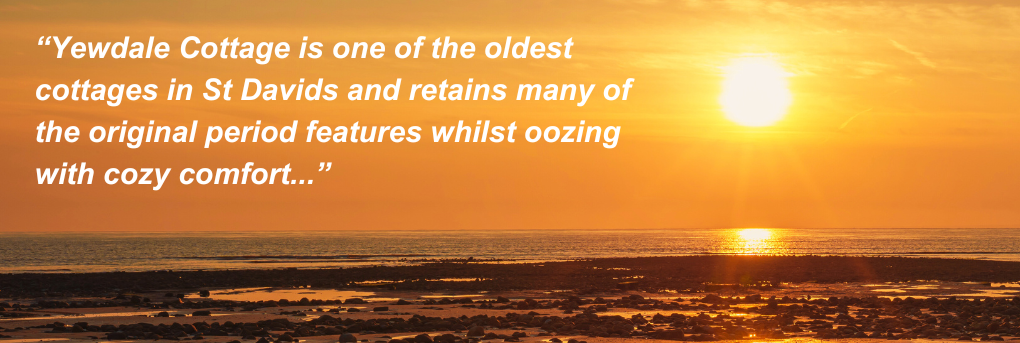
The magnificent Cathedral at St Davids dates back to the 12th century, although several older cathedrals were built before that on the same site.

Unfortunately, St Davids was prone to Viking attacks, being so close to the sea. The Vikings destroyed several of the older structures.

Modern day St Davids is a quaint and character-full place much loved by everyone who knows it.

Posted in Latest News

Dog friendly cottage

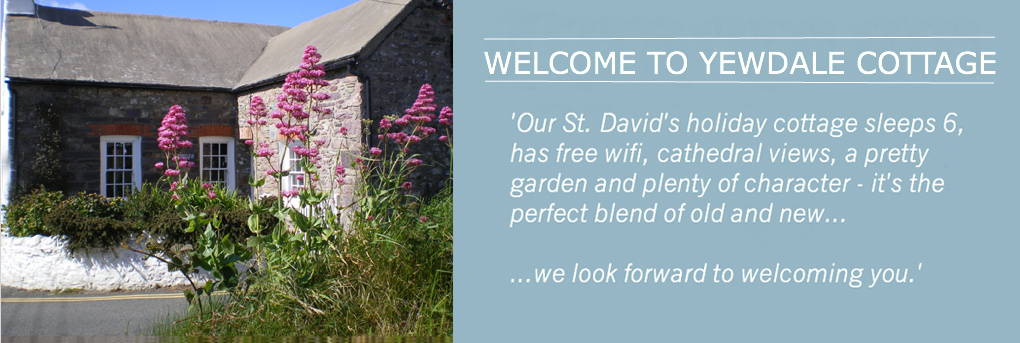
Here at Yewdale Cottage, St Davids, we totally understand the importance of bringing dogs with you on holiday. One of the reasons us three brothers have such happy memories of Pembrokeshire ourselves is because our two labradors, Fred and Henry, would always make the journey with us to West Wales when we would make our bi-annual pilgrimage.

There’s no more profoundly satisfying feeling than watching your pooches running up and down the beach, attempting to bite the tide or just getting stuck in and swimming around in the ocean. And the dogs absolutely love it too!

The beaches around St Davids are mostly dog friendly, although Whitesands Bay doesn’t allow dogs in the peak season from 1st May to 30th September. But most of the other beaches are extremely dog friendly and welcome furry friends to dig in the sand and play in the sea.

There’s also doggie ice cream to be enjoyed at St David’s famous ice cream cafe ‘The Bench’.

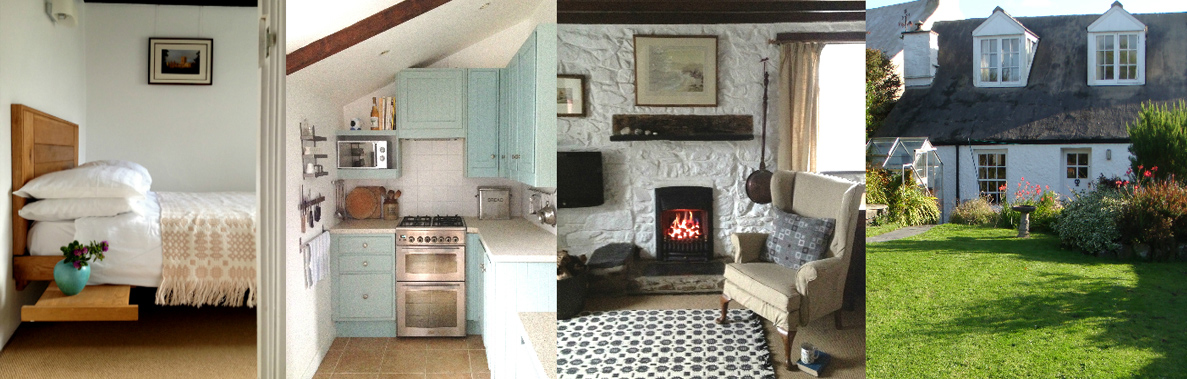
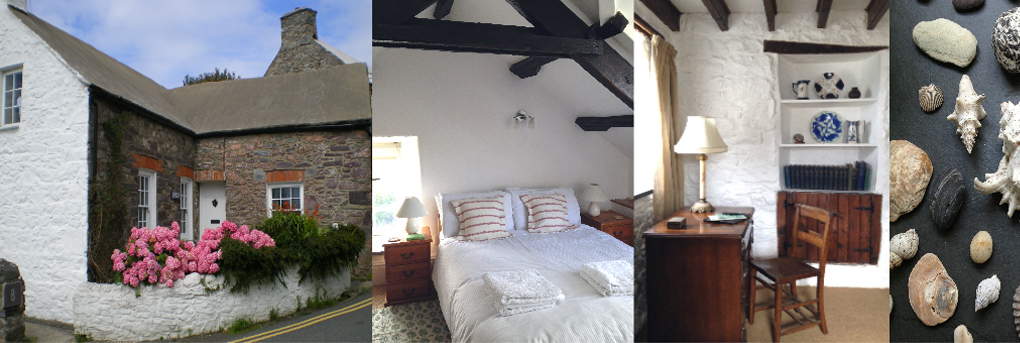
Here at Yewdale holiday cottage we offer a small supplementary fee for dogs and just ask that they don’t come upstairs. But apart from that, we welcome furry friends in all their furry forms!

Posted in Latest News